 ← Return Home
Published June 15, 2026 · Konan P. Basargin · Archeogenesis Research Series
ARCHEOGENESIS OPERATIONAL IMPLEMENTATION STANDARD

Status: Version 1.0 Initial Release

This document represents the first official implementation standard for the Archeogenesis Chain System and is subject to future revision, expansion, clarification, and refinement.

The Official Deployment, Runtime, and Technical Architecture Specification for the Archeogenesis Chain System.

DOCUMENT SCOPE
This document defines the operational interpretation, deployment methodology, runtime specification, artificial intelligence implementation model, and software implementation architecture of the Archeogenesis Chain System.

This document does not replace the foundational Archeogenesis research, systems architecture principles, or licensing documentation.

Those documents remain separate and authoritative within their respective domains.

ARCHEOGENESIS CHAIN SYSTEM
Operational Structure of Emergence, Organization, and Execution

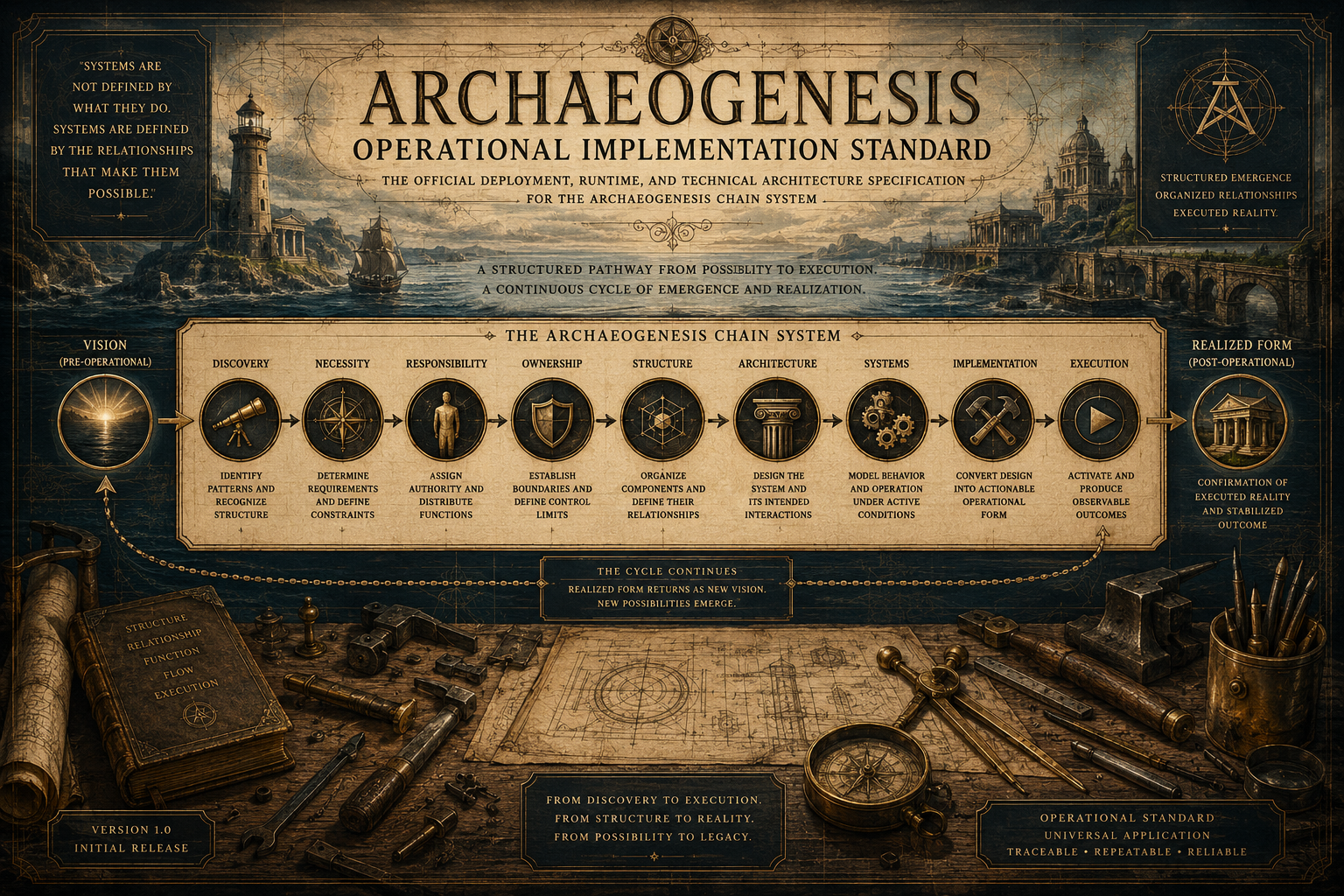
The Archeogenesis Chain System defines a structured model for transforming unstructured possibility into executed reality through a fixed sequential process. It establishes a deterministic pathway for how information, observation, and intent move through progressively refined stages until they become operational outcomes.

The system is composed of a single pre-operational layer and a fixed nine-stage operational chain. Each stage represents a necessary transformation of structure, ensuring that no output is produced without full sequential development.

VISION LAYER
Vision represents the pre-operational state of possibility. It is not part of execution and does not operate within measurable structure. Vision is the presence of potential before definition.

It contains:

undefined patterns
incomplete perception
emergent possibility
non-structured awareness

Vision does not execute. It does not validate. It only precedes structural recognition and feeds into the operational chain through transition into Discovery.

DISCOVERY
Discovery is the first operational stage of the system. It converts undefined possibility into identifiable structure.

This stage isolates meaningful patterns from raw input and separates signal from noise. It defines what is actually present within the observed state.

Output: recognized structural elements.

NECESSITY
Necessity determines what conditions must exist for structural coherence. It identifies constraints, dependencies, and required states that must be satisfied for progression.

This stage defines requirement pressure within the system.

Output: constraint and requirement map.

RESPONSIBILITY
Responsibility assigns processing authority within the system. It determines which part of the structure handles which function or transformation.

This stage ensures proper distribution of operational handling.

Output: responsibility allocation structure.

OWNERSHIP
Ownership defines boundaries of control. It establishes what can be modified, what is fixed, and what lies outside permissible transformation.

This stage stabilizes system authority and prevents uncontrolled structural change.

Output: boundary definition framework.

STRUCTURE
Structure decomposes the system into components and relationships. It organizes elements into hierarchical and relational forms, defining how parts connect and depend on each other.

Output: structured relational map.

ARCHITECTURE
Architecture defines the intended design of the system. It establishes how components should interact and how the system is meant to function under designed conditions.

Output: system design model.

SYSTEMS
Systems represent the operational behavior of architecture under simulated or active conditions. This stage defines how the structure behaves when placed into functional interaction.

Output: behavior model of the system.

IMPLEMENTATION
Implementation converts structural and architectural models into operational form. It transforms design into actionable configuration capable of execution.

Output: executable system form.

EXECUTION
Execution produces the final operational result. It is the stage where the system becomes active and generates observable outcomes.

Output: completed system action.

REALIZED FORM
Realized Form represents the state of the system after execution has occurred. It is the confirmation of produced reality and the stabilization of outcome.

From this state, new Vision emerges as new possibilities become visible through the existence of results.

LOOP STRUCTURE
The system operates in a continuous cycle:

Vision returns through Realized Form into new Vision, creating ongoing cycles of emergence and execution.

COMPLETE CHAIN STRUCTURE
Vision → Discovery → Necessity → Responsibility → Ownership → Structure → Architecture → Systems → Implementation → Execution → Realized Form → Vision

SYSTEM DEFINITION
The Archeogenesis Chain System is a structured operational framework that converts pre-structured possibility into executed reality through a fixed sequential transformation process.

It ensures that every output is the result of full structural progression through all defined stages, maintaining consistency, traceability, and controlled emergence across all applications.

OPERATIONAL BOUNDARIES OF THE CHAIN
It is important to distinguish between the Archeogenesis Chain itself and the conditions that surround it.

The formal Archeogenesis Chain begins with Discovery and concludes with Execution.

Discovery, Necessity, Responsibility, Ownership, Structure, Architecture, Systems, Implementation, and Execution constitute the complete operational chain. These stages exist within measurable reality and can be observed, examined, documented, analyzed, and traced through operational consequence.

Vision and Realized Form are not operational layers within the Archeogenesis Chain.

Vision exists before Discovery as the condition of possibility. It represents awareness, perception, recognition, and potential before those conditions become operationally traceable. Vision may inspire Discovery, but Vision itself remains outside the measurable chain.

Realized Form exists after Execution as the condition of completed existence. It represents the state in which execution has produced reality and the result now exists as an observable outcome.

For this reason, the complete visual sequence is often represented as:

Vision → Discovery → Necessity → Responsibility → Ownership → Structure → Architecture → Systems → Implementation → Execution → Realized Form → Vision

This visual sequence should not be interpreted as the formal Archeogenesis Chain.

Rather, it illustrates the relationship between the operational chain and the conditions that surround it.

The Archeogenesis Chain itself is:

Discovery → Necessity → Responsibility → Ownership → Structure → Architecture → Systems → Implementation → Execution

Vision exists before the chain.

Realized Form exists after the chain.

The return from Realized Form toward Vision represents the emergence of new possibilities created by existing reality. These possibilities may eventually become future Discoveries, beginning a new cycle of emergence.

The chain explains measurable emergence.

Vision and Realized Form explain the conditions that exist beyond the operational boundaries of the chain itself.

ARCHEOGENESIS CHAIN SYSTEM
OPERATIONAL IMPLEMENTATION & REAL-WORLD APPLICATION LAYER (PART 2)

ARCHEOGENESIS UNIVERSAL DISCOVERY LAYER
The Universal Discovery Layer represents the first operational stage of the Archeogenesis Chain. Discovery exists because no system can proceed intelligently until it understands what is present. Before requirements can be identified, before responsibilities can be assigned, before structures can be formed, the system must first determine what actually exists within the environment it is attempting to understand.

At this stage the questions are unique to Discovery. The system is not asking what should happen. The system is not asking who is responsible. The system is not asking how something should be designed. Discovery asks only questions that reveal reality.

What exists?

What is being observed?

What relationships are visible?

What patterns are emerging?

What information is relevant?

What information is noise?

What assumptions are being made?

What remains unknown?

An artificial intelligence system performs Discovery by identifying context, intent, meaning, relationships, dependencies, ambiguity, and hidden assumptions within incoming information. A software system performs Discovery by identifying inputs, events, states, dependencies, resources, and environmental conditions. An organization performs Discovery by identifying opportunities, risks, constraints, market conditions, and available resources. A human performs Discovery by observing circumstances, gathering information, recognizing patterns, and understanding the environment before action is taken.

Discovery cannot answer Necessity because Discovery does not determine what is required. Discovery only determines what exists. Once reality has been identified, the chain progresses into Necessity.

ARCHEOGENESIS UNIVERSAL NECESSITY LAYER
The Universal Necessity Layer represents the second operational stage of the Archeogenesis Chain. Necessity exists because identifying reality does not automatically reveal what is required. Discovery may reveal hundreds of conditions, observations, and relationships, but only some of them are essential to progression.

The questions asked by Necessity are different from Discovery because Necessity is concerned with requirements rather than recognition.

What must exist?

What conditions are required?

What dependencies cannot be ignored?

What constraints must be preserved?

What resources are necessary?

What relationships are critical?

What conditions would prevent progression if absent?

An artificial intelligence system uses Necessity to determine what information is essential for producing a valid response. A software system uses Necessity to identify required inputs, dependencies, operational conditions, and constraints. An organization uses Necessity to identify obligations, commitments, resources, and operational requirements. A human uses Necessity to determine what must be true before action can be taken responsibly.

Necessity cannot answer Responsibility because identifying requirements does not establish accountability. Once requirements have been identified, the chain progresses into Responsibility.

ARCHEOGENESIS UNIVERSAL RESPONSIBILITY LAYER
Responsibility represents the assignment of obligation. Once the system understands what must exist, it must determine who or what is responsible for ensuring those conditions are met.

The questions unique to Responsibility are:

Who handles this?

Who owns this obligation?

What component performs this function?

What process manages this requirement?

What actor is accountable for progression?

What responsibilities must be distributed?

An artificial intelligence system uses Responsibility to allocate reasoning pathways. A software system uses Responsibility to assign functions, services, modules, and processing routes. An organization uses Responsibility to establish accountability structures and operational ownership. A human uses Responsibility to determine which obligations belong to them and which belong elsewhere.

Responsibility cannot answer Ownership because assigning responsibility does not establish authority. Once responsibility has been assigned, the chain progresses into Ownership.

ARCHEOGENESIS UNIVERSAL OWNERSHIP LAYER
The Universal Ownership Layer represents the fourth operational stage of the Archeogenesis Chain. Ownership exists because assigning responsibility does not automatically establish authority. A system may know who is responsible for a task, condition, or requirement, but responsibility alone does not define what can be controlled, what can be modified, or what authority exists to make decisions.

Ownership establishes boundaries.

The questions unique to Ownership are:

What can be controlled?

What can be modified?

What authority exists?

What authority does not exist?

What falls within operational boundaries?

What falls outside operational boundaries?

What decisions may be made?

What decisions require approval elsewhere?

An artificial intelligence system uses Ownership to determine which conclusions can be supported by available information and which conclusions exceed the available evidence. A software system uses Ownership to define permissions, access controls, administrative authority, operational scope, and modification boundaries. An organization uses Ownership to establish decision rights, management authority, stewardship, and operational control. A human uses Ownership to determine what falls within their control, what falls outside their control, and what responsibilities they possess the authority to act upon.

Ownership exists because responsibility without authority creates paralysis, while authority without boundaries creates instability.

Ownership cannot answer Structure because authority alone does not create organization. Once authority and boundaries have been established, the chain progresses into Structure.

ARCHEOGENESIS UNIVERSAL STRUCTURE LAYER
The Universal Structure Layer represents the fifth operational stage of the Archeogenesis Chain. Structure exists because ownership alone does not create organization. Once boundaries and authority have been established, the system must determine how components relate to one another.

Structure transforms isolated elements into organized relationships.

The questions unique to Structure are:

What are the components?

How do the components relate?

What depends upon what?

What belongs together?

What should be separated?

What hierarchy exists?

What relationships are primary?

What relationships are secondary?

How does information flow between components?

An artificial intelligence system uses Structure to organize information into meaningful relationships, dependencies, and logical groupings. A software system uses Structure to organize data, functions, modules, services, and operational relationships. An organization uses Structure to define departments, reporting relationships, teams, workflows, and operational divisions. A human uses Structure to organize information, priorities, tasks, and relationships into a coherent model.

Structure exists because understanding components without understanding relationships creates fragmentation.

Structure cannot answer Architecture because organization alone does not determine design. Once relationships have been established, the chain progresses into Architecture.

ARCHEOGENESIS UNIVERSAL ARCHITECTURE LAYER
The Universal Architecture Layer represents the sixth operational stage of the Archeogenesis Chain. Architecture exists because organized components do not automatically produce an intended outcome. Once structure exists, the system must determine how those relationships are designed to function together.

Architecture transforms organization into intentional design.

The questions unique to Architecture are:

How should the system function?

How should components interact?

What is the intended outcome?

What pathways should exist?

What pathways should not exist?

How should information flow?

How should decisions be made?

What design best supports the intended purpose?

An artificial intelligence system uses Architecture to organize reasoning pathways and determine how information should move through interpretation. A software system uses Architecture to define application design, service interaction, communication pathways, and operational frameworks. An organization uses Architecture to design governance models, operational frameworks, decision structures, and management systems. A human uses Architecture to design plans, strategies, processes, and methods of achieving intended outcomes.

Architecture exists because relationships without design create randomness.

Architecture cannot answer Systems because design alone does not reveal operational behavior. Once design has been established, the chain progresses into Systems.

ARCHEOGENESIS UNIVERSAL SYSTEMS LAYER
The Universal Systems Layer represents the seventh operational stage of the Archeogenesis Chain. Systems exist because architecture alone does not reveal how a design behaves when placed into operation.

Systems transform design into interaction.

The questions unique to Systems are:

How will the design behave?

How do components interact under real conditions?

What feedback loops exist?

What dependencies emerge?

What conflicts may occur?

What outcomes become possible?

What outcomes become impossible?

How does the system respond to change?

An artificial intelligence system uses Systems to evaluate interaction between information, reasoning paths, constraints, and outputs. A software system uses Systems to evaluate behavior between services, modules, databases, interfaces, and users. An organization uses Systems to evaluate how departments, people, resources, and processes interact. A human uses Systems to mentally evaluate consequences, interactions, outcomes, and long-term effects.

Systems exist because design must be understood under operational conditions before action occurs.

Systems cannot answer Implementation because understanding behavior does not create execution. Once operational behavior is understood, the chain progresses into Implementation.

ARCHEOGENESIS UNIVERSAL IMPLEMENTATION LAYER
The Universal Implementation Layer represents the eighth operational stage of the Archeogenesis Chain. Implementation exists because understanding a system does not cause it to exist in reality.

Implementation transforms understanding into operational form.

The questions unique to Implementation are:

How is this built?

How is this deployed?

How is this activated?

What resources are required?

What sequence must occur?

What processes must be established?

How does design become operational reality?

What steps are required before execution becomes possible?

An artificial intelligence system uses Implementation to convert structured reasoning into a deliverable response. A software system uses Implementation to transform architecture and systems into operational code, infrastructure, and deployment. An organization uses Implementation to convert strategy into processes, procedures, staffing, and operations. A human uses Implementation to convert plans into actionable steps.

Implementation exists because design without activation remains theoretical.

Implementation cannot answer Execution because preparation alone does not produce results. Once implementation has been completed, the chain progresses into Execution.

ARCHEOGENESIS UNIVERSAL EXECUTION LAYER
The Universal Execution Layer represents the ninth and final operational stage of the Archeogenesis Chain. Execution exists because preparation, planning, design, organization, and implementation do not produce outcomes until action occurs.

Execution transforms possibility into reality.

The questions unique to Execution are:

What action is performed?

What outcome is produced?

What result now exists?

What consequences emerged?

What conditions changed?

What objectives were achieved?

What objectives failed?

What reality now exists because of execution?

An artificial intelligence system uses Execution to produce and deliver a final response. A software system uses Execution to perform operational functions and generate results. An organization uses Execution to carry out operations, decisions, and actions. A human uses Execution to perform action within reality.

Execution exists because all previous layers exist to support the production of an outcome.

Once Execution has occurred, the operational chain is complete.

The result becomes Realized Form.

Realized Form is not part of the operational chain. It is the state of existence produced by Execution. From Realized Form, new possibilities become visible, giving rise to future Vision and eventually future Discovery, beginning another cycle of emergence.

END OF PART 2

ARCHEOGENESIS CHAIN SYSTEM
OPERATIONAL DEPLOYMENT & IMPLEMENTATION BLUEPRINT (PART 3)
The purpose of this section is to define how the Archeogenesis Chain is operationally deployed within a system. Part 1 defined the chain. Part 2 defined how each layer functions and the questions each layer must answer. Part 3 defines how those layers are connected, how information moves between them, how progression is enforced, and how the chain becomes an operational process rather than a conceptual model.

The Archeogenesis Chain is not intended to operate as a collection of independent stages. Each layer depends upon the successful completion of the layer before it. Discovery cannot produce Responsibility. Necessity cannot produce Architecture. Structure cannot produce Execution. Every stage must emerge from the output of the previous stage.

The first principle of implementation is sequential enforcement.

A system entering the Archeogenesis Chain begins at Discovery. Discovery identifies what exists and produces a set of recognized conditions, observations, relationships, patterns, and known states. These outputs become the input of Necessity.

Necessity evaluates the discoveries and determines which conditions are required for progression. It identifies dependencies, requirements, constraints, obligations, and critical conditions. These outputs become the input of Responsibility.

Responsibility evaluates the identified requirements and determines who or what must address them. Responsibility assigns accountability, stewardship, handling domains, processing ownership, and operational obligations. These outputs become the input of Ownership.

Ownership evaluates responsibility assignments and determines authority. Ownership defines control boundaries, permissions, limitations, decision rights, and operational scope. These outputs become the input of Structure.

Structure evaluates ownership boundaries and organizes components into coherent relationships. Structure identifies hierarchy, dependencies, groupings, classifications, and organizational arrangements. These outputs become the input of Architecture.

Architecture evaluates the organized structure and determines intended design. Architecture defines interaction pathways, information flow, decision pathways, design patterns, and intended system behavior. These outputs become the input of Systems.

Systems evaluates architectural design under operational conditions. Systems identifies behavior, interaction effects, feedback relationships, dependencies, conflicts, and operational outcomes. These outputs become the input of Implementation.

Implementation evaluates system behavior and transforms design into operational form. Implementation establishes processes, procedures, deployments, actions, configurations, resources, and activation requirements. These outputs become the input of Execution.

Execution evaluates implementation readiness and produces action. Execution generates outcomes, consequences, operational results, completed actions, and observable reality.

At this point the operational chain is complete.

Execution produces Realized Form.

Realized Form is not part of the operational chain. It represents the condition in which execution has entered reality and now exists as an observable result. The existence of that result creates new possibilities, new observations, new opportunities, new problems, and new conditions. These possibilities eventually contribute to future Vision, which may later become future Discovery.

The second principle of implementation is progression integrity.

No layer may be skipped.

A system that attempts to establish Architecture before Structure will create designs without organization. A system that attempts Implementation before Systems will attempt activation without understanding operational behavior. A system that attempts Execution before Implementation will attempt action without preparation.

The chain derives its stability from sequence.

The third principle of implementation is traceability.

Every output generated by a system utilizing the Archeogenesis Chain must be traceable to the layer that produced it. Every decision must be traceable to a responsibility assignment. Every responsibility assignment must be traceable to a necessity. Every necessity must be traceable to a discovery.

Traceability ensures that the system can explain how and why outcomes emerge.

The fourth principle of implementation is universality.

The chain does not change when applied to artificial intelligence systems, software systems, organizations, engineering processes, operational workflows, or human decision-making. The environment changes. The chain does not.

An artificial intelligence system uses the chain to structure reasoning before output generation.

A software system uses the chain to structure processing before execution.

An organization uses the chain to structure governance before operation.

A human uses the chain to structure understanding before action.

The same sequence applies in every environment because the chain is not dependent upon technology, language, industry, or domain. It is dependent only upon the progression of emergence from Discovery through Execution.

The fifth principle of implementation is deployment discipline.

The purpose of the Archeogenesis Chain is not to make decisions on behalf of a system. The purpose of the Archeogenesis Chain is to ensure that decisions emerge through a structured sequence rather than through arbitrary progression.

A properly deployed Archeogenesis implementation does not guarantee correctness. It guarantees structure.

A properly deployed Archeogenesis implementation does not guarantee success. It guarantees traceability.

A properly deployed Archeogenesis implementation does not guarantee outcomes. It guarantees that outcomes emerge through an observable chain of relationships.

This is the operational blueprint of Archeogenesis.

The chain defines the sequence.

The layers define the questions.

The implementation blueprint defines how the sequence is enforced.

Together they form the complete Archeogenesis Chain System.

PART 4A
UNIVERSAL RUNTIME SPECIFICATION
Universal Runtime Notice

The following specification defines the minimum operational requirements for an Archeogenesis-compliant implementation. This specification is platform-independent and may be implemented through software systems, artificial intelligence systems, organizational workflows, decision architectures, and computational environments.

This specification is provided as a reference architecture. Implementation, testing, deployment, validation, security review, operational review, compliance review, and production use remain the responsibility of the implementer.

Runtime Objective

The objective of the Archeogenesis Runtime is to ensure that all inputs progress through the complete Archeogenesis Chain before execution occurs.

The runtime shall enforce sequential progression through:

Discovery → Necessity → Responsibility → Ownership → Structure → Architecture → Systems → Implementation → Execution

Execution shall produce Realized Form.

Realized Form shall not be considered an operational layer.

Runtime State Model

Every Archeogenesis-compliant implementation shall maintain the following operational states:

Input State

Incoming information
Signals
Conditions
Requests
Events

Discovery State

Observations
Patterns
Relationships
Known conditions

Necessity State

Constraints
Dependencies
Requirements
Mandatory conditions

Responsibility State

Assignments
Accountability mappings
Processing domains

Ownership State

Authority boundaries
Permissions
Operational scope

Structure State

Hierarchies
Relationships
Organizational mappings

Architecture State

Design pathways
Interaction models
Intended behavior

Systems State

Operational interactions
Simulations
Feedback relationships

Implementation State

Activation plans
Configuration states
Deployment requirements

Execution State

Actions
Outcomes
Results

Realized Form State

Observable reality
Completed outcome
Recorded result
Runtime Enforcement Rules

The runtime shall enforce the following progression requirements:

Discovery must complete before Necessity begins.
Necessity must complete before Responsibility begins.
Responsibility must complete before Ownership begins.
Ownership must complete before Structure begins.
Structure must complete before Architecture begins.
Architecture must complete before Systems begins.
Systems must complete before Implementation begins.
Implementation must complete before Execution begins.
Execution shall produce Realized Form.
Realized Form shall not be considered an operational chain layer.
Runtime Traceability Rules

Every output shall be traceable to its source.

Execution Output → Implementation

Implementation → Systems

Systems → Architecture

Architecture → Structure

Structure → Ownership

Ownership → Responsibility

Responsibility → Necessity

Necessity → Discovery

Discovery → Input

No output shall exist without a traceable chain of progression.

Runtime Compliance Requirements

A system may be considered Archeogenesis-compliant only if:

All operational layers exist.
Layer progression is sequential.
Outputs remain traceable.
Realized Form remains external to the chain.
Discovery remains the first operational layer.
Execution remains the final operational layer.

TECHNICAL IMPLEMENTATION NOTICE
The following Archeogenesis Runtime Engine is provided as a reference implementation demonstrating one method through which the Archeogenesis Chain may be operationalized within a software environment.

This implementation is provided for research, educational, architectural, developmental, and implementation guidance purposes only.

The Archeogenesis Chain remains platform-independent and may be implemented through alternative architectures, programming languages, frameworks, workflows, methodologies, and computational environments.

Implementation, modification, testing, validation, deployment, maintenance, operational review, security review, regulatory compliance review, performance evaluation, and production use remain solely the responsibility of the implementer.

The author makes no representation or warranty regarding fitness for any particular purpose, operational performance, reliability, availability, security, regulatory compliance, legal compliance, commercial suitability, or outcome.

Use of this implementation constitutes acceptance that all implementation decisions, modifications, integrations, deployments, and resulting consequences remain the responsibility of the implementing party.

This reference implementation is provided "AS IS" without warranty of any kind, whether express or implied.

For licensing terms, commercial deployment rights, usage restrictions, attribution requirements, and limitation of liability provisions, refer to the Archeogenesis License documentation.

# ============================================================
# ARCHEOGENESIS CHAIN SYSTEM
# UNIVERSAL RUNTIME ENGINE v1
# Reference Python Implementation
# ============================================================

from dataclasses import dataclass, field
from typing import Dict, Any


@dataclass
class ArcheogenesisState:
    input_data: Any
    discovery: Dict[str, Any] = field(default_factory=dict)
    necessity: Dict[str, Any] = field(default_factory=dict)
    responsibility: Dict[str, Any] = field(default_factory=dict)
    ownership: Dict[str, Any] = field(default_factory=dict)
    structure: Dict[str, Any] = field(default_factory=dict)
    architecture: Dict[str, Any] = field(default_factory=dict)
    systems: Dict[str, Any] = field(default_factory=dict)
    implementation: Dict[str, Any] = field(default_factory=dict)
    execution: Dict[str, Any] = field(default_factory=dict)
    realized_form: Dict[str, Any] = field(default_factory=dict)


class DiscoveryLayer:

    def execute(self, state):

        state.discovery = {
            "observations": state.input_data,
            "status": "discovered"
        }

        return state


class NecessityLayer:

    def execute(self, state):

        state.necessity = {
            "requirements": state.discovery,
            "status": "necessary"
        }

        return state


class ResponsibilityLayer:

    def execute(self, state):

        state.responsibility = {
            "assignments": state.necessity,
            "status": "assigned"
        }

        return state


class OwnershipLayer:

    def execute(self, state):

        state.ownership = {
            "authority": state.responsibility,
            "status": "owned"
        }

        return state


class StructureLayer:

    def execute(self, state):

        state.structure = {
            "relationships": state.ownership,
            "status": "structured"
        }

        return state


class ArchitectureLayer:

    def execute(self, state):

        state.architecture = {
            "design": state.structure,
            "status": "architected"
        }

        return state


class SystemsLayer:

    def execute(self, state):

        state.systems = {
            "behavior": state.architecture,
            "status": "systemized"
        }

        return state


class ImplementationLayer:

    def execute(self, state):

        state.implementation = {
            "deployment": state.systems,
            "status": "implemented"
        }

        return state


class ExecutionLayer:

    def execute(self, state):

        state.execution = {
            "result": state.implementation,
            "status": "executed"
        }

        return state


class RealizedForm:

    def record(self, state):

        state.realized_form = {
            "outcome": state.execution,
            "status": "realized"
        }

        return state


class ArcheogenesisRuntime:

    def __init__(self):

        self.discovery = DiscoveryLayer()
        self.necessity = NecessityLayer()
        self.responsibility = ResponsibilityLayer()
        self.ownership = OwnershipLayer()
        self.structure = StructureLayer()
        self.architecture = ArchitectureLayer()
        self.systems = SystemsLayer()
        self.implementation = ImplementationLayer()
        self.execution = ExecutionLayer()
        self.realized = RealizedForm()

    def process(self, input_data):

        state = ArcheogenesisState(input_data)

        state = self.discovery.execute(state)
        state = self.necessity.execute(state)
        state = self.responsibility.execute(state)
        state = self.ownership.execute(state)
        state = self.structure.execute(state)
        state = self.architecture.execute(state)
        state = self.systems.execute(state)
        state = self.implementation.execute(state)
        state = self.execution.execute(state)
        state = self.realized.record(state)

        return state


# ============================================================
# REFERENCE EXECUTION
# ============================================================

if __name__ == "__main__":

    runtime = ArcheogenesisRuntime()

    result = runtime.process(
        "Design a new AI decision framework."
    )

    print(result.realized_form)

PART 4B
AI AGENT RUNTIME
AI Runtime Purpose

The Archeogenesis AI Agent Runtime extends the Universal Runtime Specification by applying the Archeogenesis Chain directly to artificial intelligence reasoning processes.

Rather than allowing an artificial intelligence system to generate an immediate response from input, the AI Agent Runtime forces information to progress through each operational layer of the Archeogenesis Chain before response generation occurs.

This creates a traceable reasoning pathway between input and output.

The purpose of the AI Runtime is not to replace intelligence. The purpose of the AI Runtime is to structure intelligence.

The AI Runtime forces the artificial intelligence system to answer the questions associated with each layer before progression becomes possible.

Discovery identifies what exists.

Necessity identifies what must exist.

Responsibility identifies who or what handles the requirement.

Ownership establishes authority and boundaries.

Structure organizes relationships.

Architecture establishes design.

Systems evaluate interaction.

Implementation prepares action.

Execution produces output.

Through this process, responses become traceable, structured, and explainable.

AI RUNTIME NOTICE
The following AI Runtime implementation is provided as a reference architecture demonstrating one method through which the Archeogenesis Chain may be applied to artificial intelligence systems.

Artificial intelligence systems may produce inaccurate, incomplete, ambiguous, or unexpected outputs. The Archeogenesis Chain structures reasoning progression but does not guarantee correctness, completeness, factual accuracy, safety, compliance, reliability, or suitability for any specific purpose.

Human review is recommended for consequential decisions.

Implementation, deployment, validation, monitoring, security review, regulatory compliance, and operational use remain solely the responsibility of the implementing party.

This implementation is provided "AS IS" without warranty of any kind, whether express or implied.

For licensing terms, commercial deployment rights, attribution requirements, and limitation of liability provisions, refer to the Archeogenesis License documentation.

ARCHEOGENESIS AI AGENT RUNTIME v1

# ============================================================
# ARCHEOGENESIS CHAIN SYSTEM
# AI AGENT RUNTIME v1
# Reference Python Implementation
# ============================================================

from dataclasses import dataclass, field
from typing import Dict, Any


@dataclass
class AIReasoningState:

    user_input: str

    discovery: Dict[str, Any] = field(default_factory=dict)
    necessity: Dict[str, Any] = field(default_factory=dict)
    responsibility: Dict[str, Any] = field(default_factory=dict)
    ownership: Dict[str, Any] = field(default_factory=dict)
    structure: Dict[str, Any] = field(default_factory=dict)
    architecture: Dict[str, Any] = field(default_factory=dict)
    systems: Dict[str, Any] = field(default_factory=dict)
    implementation: Dict[str, Any] = field(default_factory=dict)
    execution: Dict[str, Any] = field(default_factory=dict)


class ArcheogenesisAIAgent:

    def discovery_layer(self, state):

        state.discovery = {
            "questions": [
                "What exists?",
                "What is being observed?",
                "What relationships are present?",
                "What remains unknown?"
            ]
        }

    def necessity_layer(self, state):

        state.necessity = {
            "questions": [
                "What must exist?",
                "What constraints exist?",
                "What dependencies exist?"
            ]
        }

    def responsibility_layer(self, state):

        state.responsibility = {
            "questions": [
                "Who handles this?",
                "What function is responsible?",
                "What processing path applies?"
            ]
        }

    def ownership_layer(self, state):

        state.ownership = {
            "questions": [
                "What authority exists?",
                "What boundaries exist?",
                "What conclusions are supported?"
            ]
        }

    def structure_layer(self, state):

        state.structure = {
            "questions": [
                "How should information be organized?",
                "What relationships are primary?",
                "What hierarchy exists?"
            ]
        }

    def architecture_layer(self, state):

        state.architecture = {
            "questions": [
                "How should reasoning flow?",
                "What design best fits the problem?"
            ]
        }

    def systems_layer(self, state):

        state.systems = {
            "questions": [
                "What interactions occur?",
                "What consequences emerge?",
                "What conflicts exist?"
            ]
        }

    def implementation_layer(self, state):

        state.implementation = {
            "questions": [
                "How should understanding be expressed?",
                "What action path should be taken?"
            ]
        }

    def execution_layer(self, state):

        state.execution = {
            "final_output":
                f"Archeogenesis processing complete: {state.user_input}"
        }

    def process(self, user_input):

        state = AIReasoningState(user_input)

        self.discovery_layer(state)
        self.necessity_layer(state)
        self.responsibility_layer(state)
        self.ownership_layer(state)
        self.structure_layer(state)
        self.architecture_layer(state)
        self.systems_layer(state)
        self.implementation_layer(state)
        self.execution_layer(state)

        return state


# ============================================================
# REFERENCE EXECUTION
# ============================================================

if __name__ == "__main__":

    agent = ArcheogenesisAIAgent()

    result = agent.process(
        "Design a new decision framework."
    )

    print(result.execution)


PART 4C
FULL SOFTWARE ENGINE
Software Engine Purpose

The Archeogenesis Software Engine represents a complete software architecture implementation of the Archeogenesis Chain System.

Where the Universal Runtime Specification defines the operational requirements and the AI Agent Runtime defines structured reasoning progression, the Software Engine defines a deployable architecture through which applications, workflows, services, agents, automation systems, enterprise systems, and computational environments may operationalize the Archeogenesis Chain.

The Software Engine treats each Archeogenesis layer as an independent processing module operating within a controlled state-transition environment.

Every input entering the engine must progress sequentially through Discovery, Necessity, Responsibility, Ownership, Structure, Architecture, Systems, Implementation, and Execution before an operational result may be produced.

The purpose of the Software Engine is not to determine outcomes. The purpose of the Software Engine is to ensure that outcomes emerge through a structured, traceable, and enforceable progression model.

SOFTWARE ENGINE NOTICE
The following Software Engine implementation is provided as a reference architecture demonstrating one method through which the Archeogenesis Chain may be operationalized within software systems.

Implementation, modification, testing, validation, deployment, maintenance, monitoring, security review, compliance review, performance evaluation, and operational use remain solely the responsibility of the implementing party.

The Archeogenesis Chain provides a structural methodology and does not replace engineering review, security analysis, fault-tolerance testing, quality assurance procedures, governance controls, operational safeguards, or regulatory compliance requirements.

This implementation is provided "AS IS" without warranty of any kind, whether express or implied.

For licensing terms, commercial deployment rights, attribution requirements, and limitation of liability provisions, refer to the Archeogenesis License documentation.

ARCHEOGENESIS SOFTWARE ENGINE v1

# ============================================================
# ARCHEOGENESIS CHAIN SYSTEM
# SOFTWARE ENGINE v1
# Reference Python Implementation
# ============================================================

from dataclasses import dataclass, field
from typing import Dict, Any, List


@dataclass
class EngineState:

    input_data: Any

    layer_history: List[str] = field(default_factory=list)

    discovery: Dict[str, Any] = field(default_factory=dict)
    necessity: Dict[str, Any] = field(default_factory=dict)
    responsibility: Dict[str, Any] = field(default_factory=dict)
    ownership: Dict[str, Any] = field(default_factory=dict)
    structure: Dict[str, Any] = field(default_factory=dict)
    architecture: Dict[str, Any] = field(default_factory=dict)
    systems: Dict[str, Any] = field(default_factory=dict)
    implementation: Dict[str, Any] = field(default_factory=dict)
    execution: Dict[str, Any] = field(default_factory=dict)
    realized_form: Dict[str, Any] = field(default_factory=dict)


class BaseEngineModule:

    name = "base"

    def process(self, state):
        raise NotImplementedError


class DiscoveryModule(BaseEngineModule):

    name = "Discovery"

    def process(self, state):

        state.discovery = {
            "identified_input": state.input_data
        }

        state.layer_history.append(self.name)

        return state


class NecessityModule(BaseEngineModule):

    name = "Necessity"

    def process(self, state):

        state.necessity = {
            "requirements": state.discovery
        }

        state.layer_history.append(self.name)

        return state


class ResponsibilityModule(BaseEngineModule):

    name = "Responsibility"

    def process(self, state):

        state.responsibility = {
            "assignments": state.necessity
        }

        state.layer_history.append(self.name)

        return state


class OwnershipModule(BaseEngineModule):

    name = "Ownership"

    def process(self, state):

        state.ownership = {
            "authority": state.responsibility
        }

        state.layer_history.append(self.name)

        return state


class StructureModule(BaseEngineModule):

    name = "Structure"

    def process(self, state):

        state.structure = {
            "relationships": state.ownership
        }

        state.layer_history.append(self.name)

        return state


class ArchitectureModule(BaseEngineModule):

    name = "Architecture"

    def process(self, state):

        state.architecture = {
            "design": state.structure
        }

        state.layer_history.append(self.name)

        return state


class SystemsModule(BaseEngineModule):

    name = "Systems"

    def process(self, state):

        state.systems = {
            "behavior": state.architecture
        }

        state.layer_history.append(self.name)

        return state


class ImplementationModule(BaseEngineModule):

    name = "Implementation"

    def process(self, state):

        state.implementation = {
            "deployment": state.systems
        }

        state.layer_history.append(self.name)

        return state


class ExecutionModule(BaseEngineModule):

    name = "Execution"

    def process(self, state):

        state.execution = {
            "result": state.implementation
        }

        state.layer_history.append(self.name)

        return state


class RealizedFormRecorder:

    def process(self, state):

        state.realized_form = {
            "outcome": state.execution,
            "history": state.layer_history
        }

        return state


class ArcheogenesisSoftwareEngine:

    def __init__(self):

        self.modules = [

            DiscoveryModule(),
            NecessityModule(),
            ResponsibilityModule(),
            OwnershipModule(),
            StructureModule(),
            ArchitectureModule(),
            SystemsModule(),
            ImplementationModule(),
            ExecutionModule()

        ]

        self.realized_form = RealizedFormRecorder()

    def execute(self, input_data):

        state = EngineState(input_data)

        for module in self.modules:
            state = module.process(state)

        state = self.realized_form.process(state)

        return state


# ============================================================
# REFERENCE EXECUTION
# ============================================================

if __name__ == "__main__":

    engine = ArcheogenesisSoftwareEngine()

    result = engine.execute(
        "Create a new enterprise decision platform."
    )

    print(result.realized_form)


IMPLEMENTATION STANDARD CONCLUSION
The Archeogenesis Chain System defines a structured pathway through which information progresses from Discovery to Execution through a fixed sequence of operational transformations.

Part 1 defines the chain.

Part 2 defines the operational interpretation of each layer.

Part 3 defines deployment and progression rules.

Part 4 defines technical implementation standards.

Together these sections establish the Version 1.0 Archeogenesis Operational Implementation Standard.

Future revisions may expand runtime specifications, implementation standards, certification requirements, interoperability standards, deployment models, and supporting documentation while preserving the foundational structure of the Archeogenesis Chain.

END OF IMPLEMENTATION STANDARD