Published June 11, 2026 · Konan P. Basargin · Archeogenesis Research Series
Systems Architecture Principles and Systems Design Logic
Systems are not defined by what they do. Systems are defined by the relationships that make them possible.
Introduction
Systems exist everywhere. Human beings live within systems, depend upon systems, inherit systems, modify systems, and create systems. Entire civilizations are sustained by systems that most people never consciously observe. Transportation systems move resources and people across vast distances. Economic systems coordinate exchange. Communication systems transfer information. Governments operate through administrative systems. Technologies function through technical systems. Organizations rely upon operational systems. The modern world is not merely influenced by systems; it is constructed through them. Despite this reality, systems remain among the least understood structures in human experience.
One reason for this misunderstanding is that people naturally focus on outcomes rather than relationships. Outcomes are visible. Relationships are not. A bridge is judged by whether it stands. A company is judged by whether it grows. A government is judged by whether it functions. A technology platform is judged by whether it performs. Success and failure become the dominant measures through which systems are evaluated. The deeper relationship structures responsible for producing those outcomes often remain hidden beneath the surface. As long as the outcome appears satisfactory, the underlying relationships receive little attention. Only when failure occurs do people begin asking questions about structure, design, dependency, and operation.
This tendency creates a significant limitation in how systems are understood. If systems are evaluated solely through outcomes, then understanding becomes reactive rather than proactive. Problems are examined after they become visible. Dependencies are examined after they fail. Architectural weaknesses are examined after consequences emerge. Yet the relationships responsible for those consequences existed long before the consequences became visible. The system was already behaving according to its structure. Observation simply arrived late.
The purpose of this publication is to move attention away from outcomes and toward relationships. The Archeogenesis framework explains how meaningful structures emerge through Discovery, Necessity, Responsibility, Ownership, Structure, Architecture, Systems, Implementation, and Execution. That sequence explains emergence. This publication examines what occurs after emergence. It examines the operational layer where architecture enters reality and relationships become active. It examines the point where design becomes behavior and where behavior begins producing consequences.
Systems occupy a unique position within the Archeogenesis Chain because they represent the transition from intention to operation. Before systems, relationships may be recognized, justified, organized, and designed. Within systems, those relationships become active. They begin influencing reality. They begin interacting with other relationships. They begin generating outcomes that can be observed, measured, questioned, and studied. The systems layer therefore represents the beginning of operational reality. It is the point at which architecture ceases to be a design and becomes an active participant within existence.
Systems as Operational Relationships
One of the most common misunderstandings in systems design is the belief that systems are collections of components. This assumption appears reasonable because components are visible. Buildings can be observed. Departments can be observed. Technologies can be observed. Resources can be observed. Infrastructure can be observed. Yet visibility often creates confusion because the visible component is mistaken for the system itself. In reality, systems are not primarily defined by components. Systems are defined by the relationships connecting those components.
A collection of components without relationships does not become a system. It becomes inventory. Components provide potential. Relationships create capability. A city is not merely a collection of buildings. A city emerges through transportation relationships, communication relationships, economic relationships, governance relationships, and human relationships. Buildings provide physical structure. Relationships create behavior. The same principle applies to organizations, technologies, institutions, and civilizations. Components provide form. Relationships create operation.
This distinction is fundamental because behavior emerges from relationships rather than objects. Two systems may contain identical components and produce entirely different outcomes because the relationships connecting those components differ. The behavior of a system is not determined solely by what exists within it. Behavior is determined by how existence is organized. Systems therefore cannot be understood by examining components in isolation. Understanding requires examining interaction.
Relationships create patterns. Patterns create behavior. Behavior creates outcomes. This progression appears repeatedly across every domain where systems exist. The observer encounters the outcome. The systems designer studies the relationships responsible for producing it. The difference between those perspectives is the difference between observing consequence and understanding cause.
Architecture and Systems
Architecture and systems are frequently treated as interchangeable concepts, yet they represent distinct layers within the Archeogenesis framework. Architecture describes intended relationships. Systems perform actual relationships. Architecture explains how interaction should occur. Systems reveal how interaction does occur. Architecture exists before operation. Systems exist during operation.
This distinction becomes increasingly important as complexity expands. A blueprint may describe a building with extraordinary precision. Once the building enters reality, however, additional relationships emerge. Human behavior introduces variability. Environmental conditions introduce variability. Resource constraints introduce variability. Time introduces variability. The completed structure begins generating operational behavior that extends beyond the original design. The architecture remains important, but operation begins revealing information unavailable during design.
The same principle appears within organizations. Organizational charts describe intended authority. Actual authority frequently emerges through relationships that extend beyond formal structure. The same principle appears within technology. Design documents describe intended information flow. Operational platforms reveal actual information flow. The same principle appears within governments, institutions, and civilizations. Architecture establishes possibility. Systems reveal reality.
This is why systems occupy their own position within the chain. They are not merely extensions of architecture. They represent architecture entering operation. They represent the moment relationships become active. They represent the beginning of consequence.
Dependency and Interdependence
Every system depends upon relationships that extend beyond itself. Dependency is not an exception. Dependency is a characteristic of existence. Nothing operates independently. Every operational structure relies upon conditions, resources, relationships, or environments that exist beyond its immediate boundaries. A bridge depends upon material integrity. A software platform depends upon infrastructure. An organization depends upon communication. A government depends upon legitimacy. A civilization depends upon resources.
Dependency creates capability because relationships enable systems to perform functions impossible in isolation. Dependency also creates vulnerability because disruption of critical relationships can alter behavior. For this reason dependency should not be understood as weakness. Dependency should be understood as reality.
The challenge facing systems designers is not eliminating dependency. The challenge is understanding dependency. Hidden dependencies create hidden risk. Visible dependencies create manageable risk. Many systemic failures occur not because dependencies exist but because dependencies remain poorly understood. When disruption occurs, people frequently discover relationships they never recognized despite relying upon them continuously.
Understanding dependency therefore becomes an exercise in awareness. The greater the system becomes, the greater the importance of visibility. Systems cannot eliminate reliance. They can only improve understanding of the relationships sustaining operation.
The Operational Boundaries of Archeogenesis: Vision, Discovery, Realized Form, and the Perpetual Cycle of Possibility
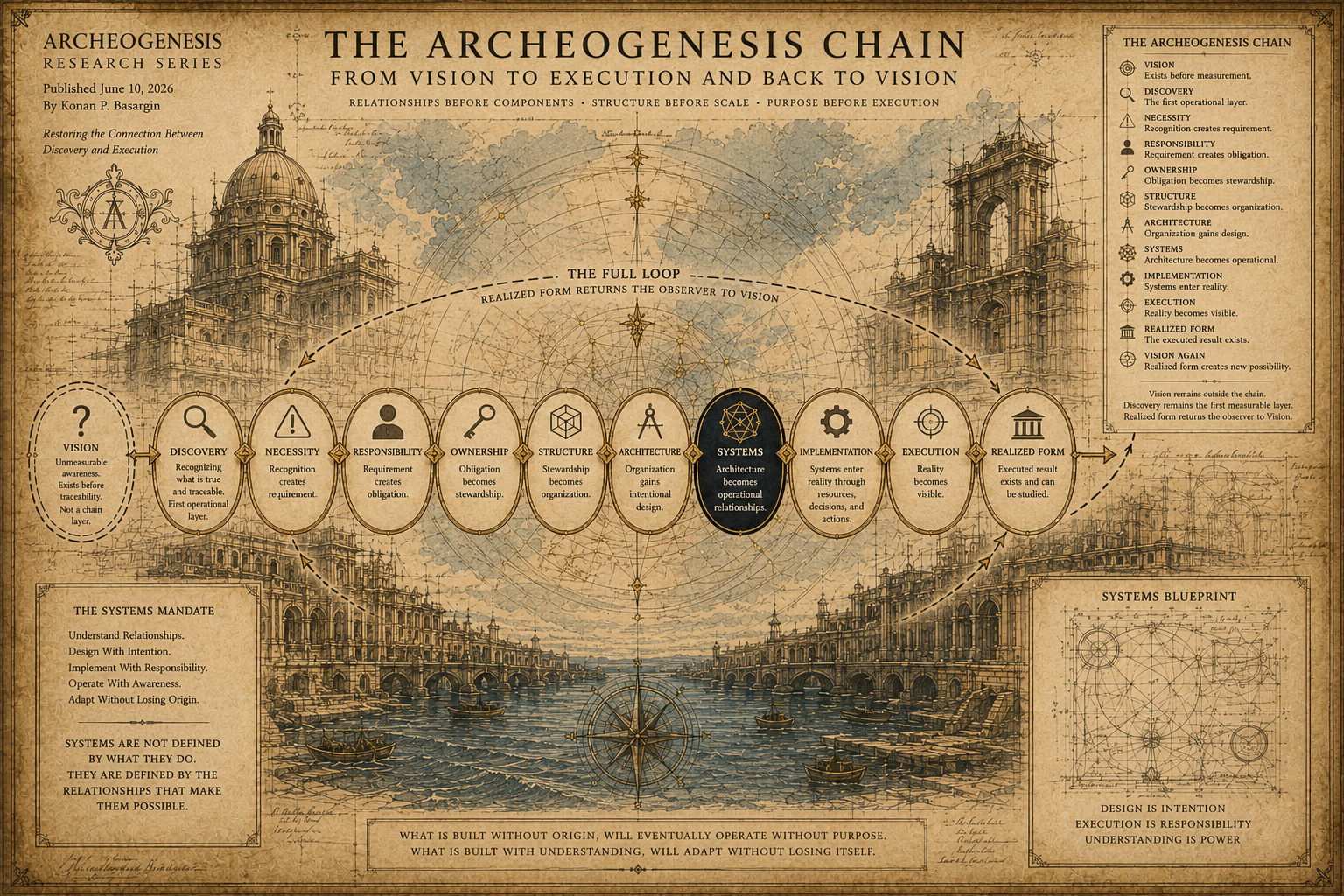
One of the most important distinctions within the Archeogenesis framework concerns the difference between what can be operationally measured and what can only be cognitively experienced. This distinction is not merely philosophical; it is foundational to the structure of the framework itself. It explains why the Archeogenesis Chain begins where it begins, why it ends where it ends, and why the hero illustration intentionally depicts relationships that extend beyond the formal boundaries of the chain. The chain itself consists of Discovery, Necessity, Responsibility, Ownership, Structure, Architecture, Systems, Implementation, and Execution. These layers represent the measurable progression through which possibility becomes reality. Each layer can be observed, examined, questioned, challenged, documented, analyzed, and traced through operational consequence. Together they form a sequence of relationships that exist within reality itself and can therefore be studied through evidence.
The hero illustration, however, intentionally depicts something beyond the operational sequence. It depicts Vision before Discovery and a return toward Vision after Realized Form. This visual representation is not intended to suggest that Vision and Realized Form are additional layers within the formal Archeogenesis Chain. Instead, it acknowledges a reality that has always existed within human experience and continues to exist regardless of whether it can be measured. Before every discovery there exists the possibility of discovery. Before every invention there exists the possibility of invention. Before every system, structure, institution, technology, civilization, or achievement enters reality, there exists the possibility that such a thing may eventually emerge. Human beings experience this condition constantly. They imagine, observe, question, speculate, recognize patterns, and perceive opportunities before sufficient evidence exists to operationally verify what they perceive.
This condition is represented by Vision. Vision should not be misunderstood as fantasy or speculation. Rather, Vision represents the cognitive capacity to perceive possibilities before those possibilities become operationally traceable. It reflects humanity's ability to recognize patterns, relationships, opportunities, and future conditions before those conditions can be consistently examined through evidence. This capability is essential to discovery itself. Without the ability to perceive possibilities beyond current understanding, discovery would rarely occur. Scientific advancement, technological innovation, exploration, invention, and even the asking of meaningful questions all depend upon the human ability to envision something that does not yet exist in measurable form.
Yet despite its importance, Vision presents a challenge. Vision cannot be reliably measured. It cannot be consistently tested. It cannot be universally verified. Two individuals may possess different visions regarding the same future possibility. Both may be intelligent. Both may be sincere. Both may genuinely believe they perceive an important relationship. One may eventually prove correct, neither may prove correct, or both may be partially correct. At the moment Vision exists, however, there is no reliable operational method for determining its validity. Vision exists within awareness. Vision exists within cognition. Vision exists within possibility. Possibility alone, however, does not establish measurable reality.
This distinction explains why Archeogenesis does not formally begin with Vision. The framework does not deny Vision, diminish Vision, or reject Vision. On the contrary, Vision is acknowledged as a necessary condition of discovery. The framework simply recognizes that Vision exists outside the boundaries of operational traceability. Discovery changes that condition. Discovery represents the first moment at which possibility becomes traceable. Something that previously existed only as a possibility becomes recognizable. Something previously uncertain becomes observable. Something previously imagined becomes capable of examination. Discovery transforms possibility into evidence. Discovery transforms awareness into traceability. Discovery transforms a cognitive perception into something that can now be investigated within reality itself. For this reason Discovery occupies the first formal position within Archeogenesis. Discovery is not necessarily the first thing that occurs within human cognition, but it is the first thing that occurs within measurable reality.
Once Discovery occurs, the remainder of the chain unfolds through increasingly operational relationships. Discovery reveals requirements, which become Necessity. Necessity creates obligations, which become Responsibility. Responsibility requires stewardship, which becomes Ownership. Ownership requires organization, which becomes Structure. Structure requires intentional design, which becomes Architecture. Architecture must become operational, which becomes Systems. Systems must enter reality, which becomes Implementation. Implementation must produce consequence, which becomes Execution. Each layer creates conditions that can be observed, measured, analyzed, and challenged through operational evidence. This grounding in measurable reality is one of the defining characteristics of Archeogenesis. The framework is not primarily concerned with what may be imagined; it is concerned with how reality emerges once imagination becomes traceable.
A similar distinction appears at the opposite end of the chain. Execution produces consequence. Consequence produces existence. Existence produces Realized Form. Realized Form represents the condition in which something has fully entered reality. The idea now exists. The architecture now exists. The system now exists. The implementation now exists. The consequence now exists. Reality has been produced. At this stage the measurable sequence has reached completion. The observer can examine the result, study the evidence, and trace the relationships responsible for producing the outcome. Operationally, the chain has fulfilled its purpose.
Yet reality itself creates a new condition. Once something exists, new possibilities emerge because it exists. Every invention creates opportunities that did not previously exist. Every discovery creates future discoveries. Every system creates opportunities for additional systems. Every realized form alters the environment in which future possibilities emerge. This is where the return toward Vision occurs. The observer encounters reality and begins asking new questions. New relationships become visible. New opportunities become imaginable. New futures become conceivable. The observer returns toward possibility.
This second Vision differs from the first. The first Vision exists before evidence. The second Vision exists after evidence. The first Vision represents possibility before understanding. The second Vision represents possibility informed by understanding. Yet despite these differences, both occupy the same position outside the operational chain. Neither can be consistently measured. Neither can be operationally verified. Neither can be examined through the same methods applied to Discovery, Necessity, Responsibility, Ownership, Structure, Architecture, Systems, Implementation, or Execution. Both belong to awareness rather than operational traceability.
For this reason, the loop illustrated around the Archeogenesis Chain should not be interpreted as additional framework layers. The loop represents the perpetual condition surrounding the framework itself. The chain represents measurable emergence. The loop represents continuous possibility. The chain explains how reality becomes operational. The loop explains why reality continuously generates future possibilities. The chain explains how existence emerges. The loop explains why emergence never truly ends. Vision therefore remains outside the chain not because it lacks importance, but because it exceeds the boundaries of operational measurement. Realized Form returns the observer toward Vision not because the chain continues beyond Execution, but because reality itself continuously generates future possibilities that cannot yet be measured.
Archeogenesis intentionally begins where traceability begins and intentionally concludes where operational consequence is produced. Everything between Discovery and Execution belongs to measurable emergence. Everything surrounding those boundaries belongs to the perpetual cycle of possibility that makes emergence possible in the first place. The chain explains what can be traced. The surrounding loop explains what can be envisioned. Together they describe the relationship between measurable reality and the endless field of possibility from which measurable reality continuously emerges.